
In today’s digital energy landscape, oil data management is a strategic necessity—not just an IT function. From exploration and drilling to production optimization and asset performance management, data drives operational, financial, and regulatory decisions across upstream, midstream, and downstream operations.
Yet many organizations still operate with siloed systems, inconsistent well identifiers, fragmented production records, and disconnected geospatial data. The result is delayed reporting, unreliable analytics, and inefficient decision-making. Effective oil and gas data management solves this by creating trusted, governed, and integrated data foundations that power digital transformation.
Why Master Data Management Is Critical in Oil and Gas
The oil and gas industry generates enormous volumes of complex information, including:
-
Exploration data
-
Upstream data from drilling and completions
-
Well data management records
-
Production data management streams from SCADA and IoT
-
Geospatial data systems
-
Asset performance management metrics
Without structured governance, these datasets become inconsistent and unreliable. According to best practices promoted by organizations such as the Society of Petroleum Engineers and advisory research from Gartner, master data governance is foundational to digital maturity and analytics success.
Master Data Management (MDM) establishes:
-
A single source of truth for wells, fields, and assets
-
Standardized definitions across departments
-
Improved oil and gas analytics capabilities
-
Stronger compliance and reporting accuracy
For companies investing in modern oil and gas digital solutions, MDM ensures those technologies deliver measurable operational value.
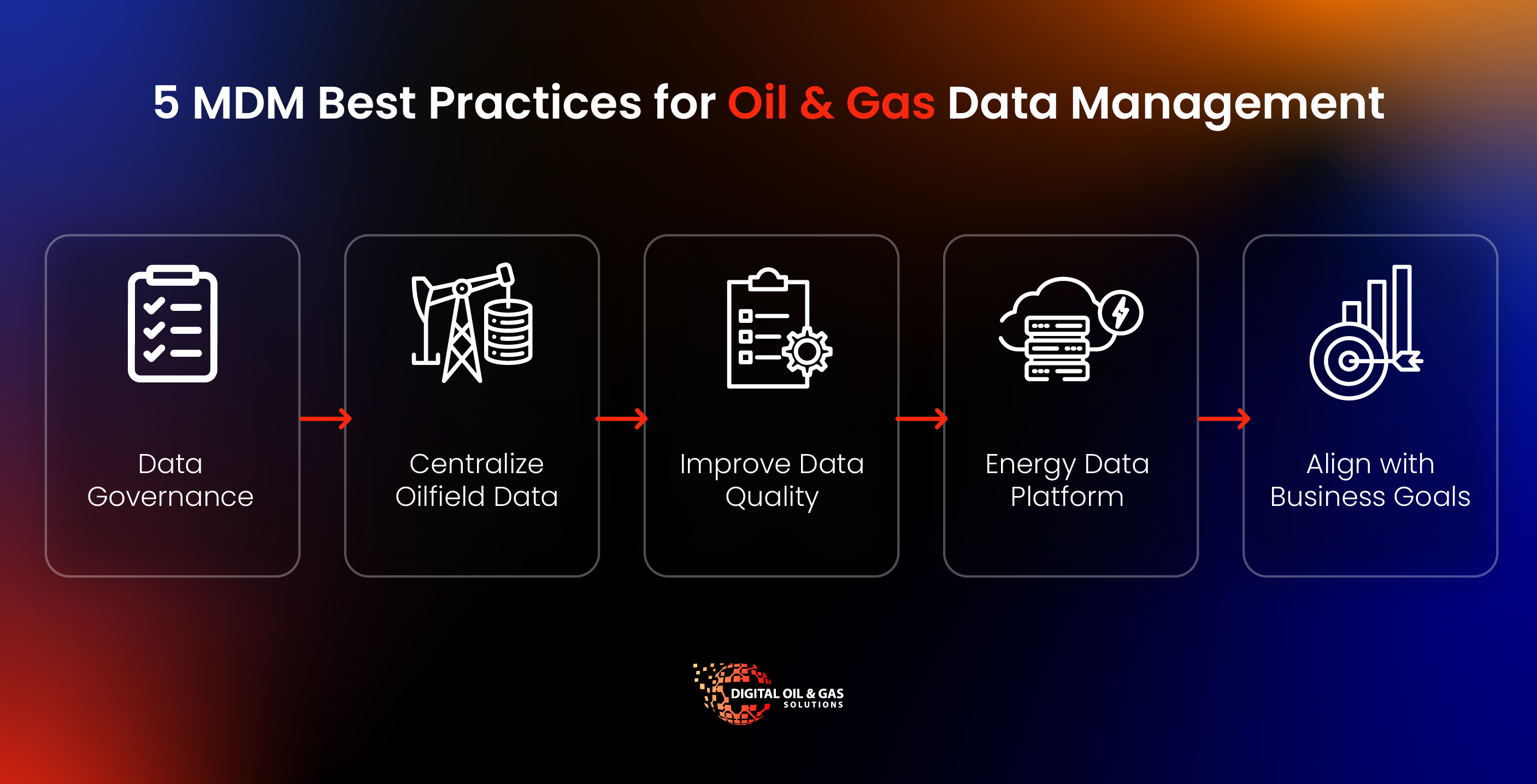
#1: Establish a Robust Data Governance Framework
Effective oil data management begins with governance. Data governance in energy defines ownership, accountability, and quality standards for critical master data entities.
Key steps include:
Assign Data Ownership - Designate business data stewards for wells, production assets, facilities, and vendor records.
Standardize Definitions - Ensure engineering, operations, and finance use consistent terminology for assets and performance metrics.
Define Data Quality KPIs - Measure completeness, consistency, timeliness, and accuracy.
Implement Oversight Structures - Create cross-functional governance councils to align petroleum data management with business objectives.
Without governance, even advanced digital oilfield solutions cannot deliver reliable insights. Governance ensures data integrity across operational and enterprise systems.
#2: Centralize Upstream and Oilfield Data
Upstream oil and gas data often resides in isolated platforms—geological tools, drilling systems, production monitoring software, and ERP applications. This fragmentation limits visibility and slows decisions.
Centralization does not require replacing all systems. Instead, organizations should:
-
Create a unified master data layer
-
Harmonize well and asset identifiers
-
Integrate structured and unstructured oilfield data management systems
When centralized:
-
Engineers can link drilling performance to production outcomes.
-
Finance teams gain accurate cost-per-barrel analysis.
-
Operations improve asset performance management monitoring.
A centralized foundation strengthens analytics and enables scalable digital transformation initiatives. Companies implementing integrated architecture through comprehensive oil and gas digital solutions often see faster reporting cycles and improved operational alignment.
#3: Improve Well and Production Data Management Quality
High-quality operational data is essential for reliable oil and gas analytics.
Well Data Management
Wells are core master entities. However, they often suffer from:
-
Multiple naming conventions
-
Changing ownership records
-
Inconsistent regulatory identifiers
A strong data management strategy ensures each well has a persistent unique identifier, standardized metadata, and a traceable ownership change history.
Production Data Management
Production data management relies heavily on SCADA and IoT in oil and gas sensors. Common challenges include:
-
Missing or delayed data feeds
-
Duplicate equipment tags
-
Inconsistent units of measurement
To improve quality:
-
Implement automated validation rules
-
Use anomaly detection to flag irregular production patterns
-
Standardize naming and measurement conventions
Organizations strengthening their approach to data analysis in oil and gas can significantly enhance forecasting accuracy, regulatory reporting, and optimization strategies.
#4: Leverage an Energy Data Platform for a Single Source of Truth
Technology enables scalable oil and gas data management. A modern energy dataplatform consolidates master data, integrates upstream and downstream systems, and supports advanced analytics.
An effective platform should offer:
Interoperability – Seamless integration with ERP, drilling, SCADA, and exploration systems.
Scalability – Capability to manage high-volume oil exploration data and IoT streams.
Built-in Governance Controls – Role-based access, audit trails, and data lineage tracking.
Analytics Readiness – Direct support for production optimization and predictive maintenance use cases.
By unifying operational technology (OT) and enterprise IT systems, organizations can build stronger digital oilfield solutions that deliver real-time operational insights.
#5: Align MDM with Business Outcomes
Master Data Management should directly support operational and financial performance—not operate as a standalone IT project.
Link oil data management initiatives to measurable KPIs such as:
-
Reduced non-productive time (NPT)
-
Improved asset uptime
-
Faster regulatory reporting
-
Enhanced capital planning accuracy
-
Lower data reconciliation effort
Track improvements such as reduced duplicate well records, faster reporting cycles, and improved forecasting precision from higher-quality production data management.
When executives see quantifiable impact, MDM becomes a strategic enabler of growth and efficiency.
Conclusion: Turning Data into a Strategic Asset
Oil and gas companies generate vast volumes of upstream data, production metrics, geospatial data systems, and asset records. But value is created only when that data is governed, centralized, standardized, and aligned with operational objectives.
By implementing these five best practices—governance, centralization, data quality management, energy data platform deployment, and KPI alignment—organizations can unlock:
-
Stronger analytics
-
Improved asset performance management outcomes
-
More reliable regulatory reporting
-
Scalable digital transformation
Mastering oil and gas data management is not optional in today’s competitive energy landscape—it is foundational to sustainable performance.
Ready to master your oil and gas data? Contact us to learn more about our comprehensive data management solutions.